Context
In September 2026 I joined Chicken Wings BUT, the Brno University of Technology team competing in SAE Aero Design, Micro Class. Picking the propulsion system (motor, propeller, ESC and battery) is one of the biggest levers on how much payload the plane can carry. With hundreds of possible parts, it’s far too many combinations to compare by hand.
So I wrote a tool that does it.
What it does
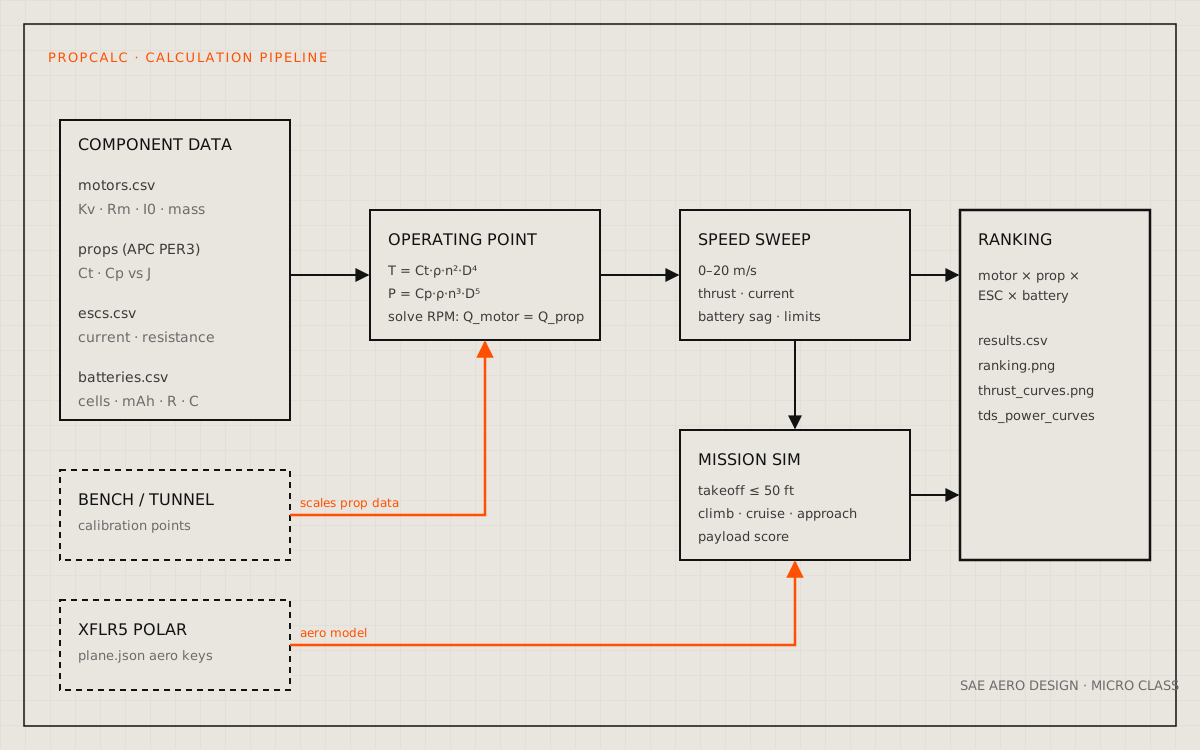
propcalc tries every legal motor × prop × ESC × battery combination from its data files, filters out anything that breaks the competition rules or a component rating, and ranks the rest. It also draws the graphs the team needs: thrust and current vs. airspeed, payload vs. current, and thrust available vs. drag.
The same calculator runs in the browser, and it redeploys automatically to Cloudflare Pages on every merge.
How it works
For each combination and airspeed, it finds the RPM where motor torque equals propeller torque:
- The propeller is modelled from APC’s published coefficient tables: thrust
T = Ct·ρ·n²·D⁴and powerP = Cp·ρ·n³·D⁵. - The motor is modelled from Kv, winding resistance and no-load current. The ESC and battery add their own resistances, so battery voltage sag under load is included.
- The prop data is calibrated against real bench tests, scaled by blade tip speed so a measurement on one prop size carries over to similar ones.
With a plane defined (wing area, drag polar, masses), it then simulates the mission: takeoff within 50 ft, climb, cruise and approach. It ranks combinations by the competition’s flight score instead of raw thrust. The aerodynamic model can be imported straight from an XFLR5 export.